Transdisciplinary research: connecting knowledge, planning and improvement
Shared purpose, continual learning and improvement that helps people flourish.
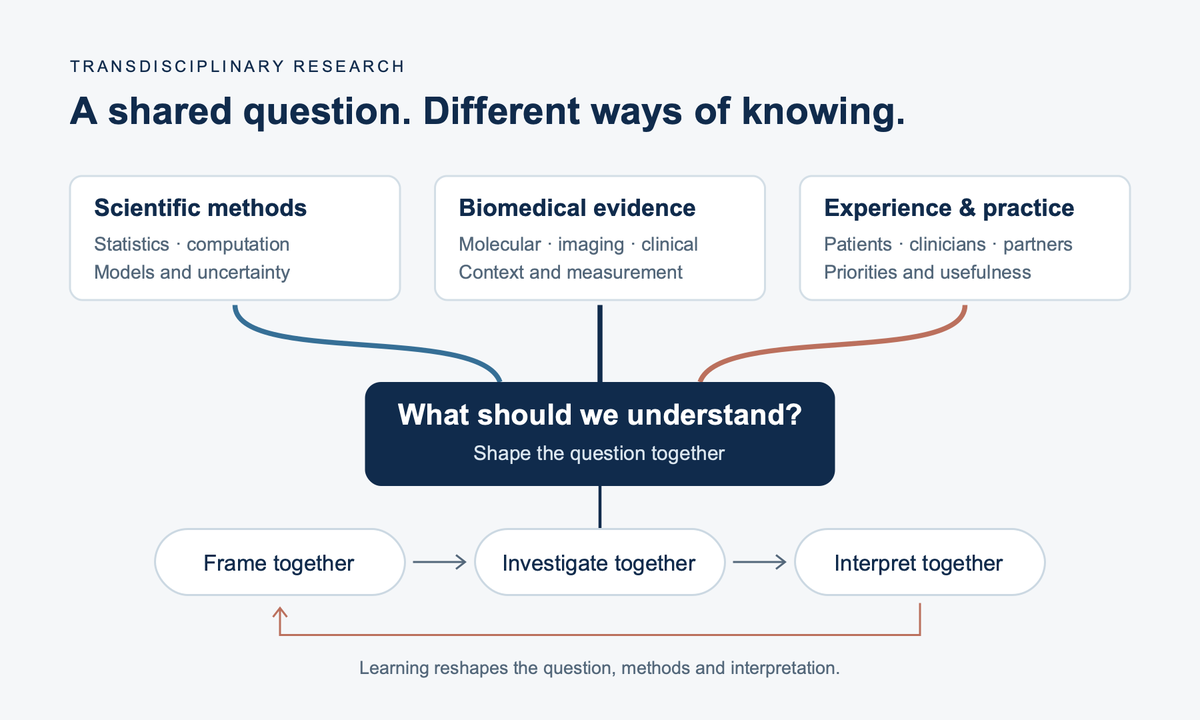 One way to organise shared inquiry, including practical perspectives. Original conceptual illustration; the text discusses broader traditions of transdisciplinarity.
People bring different knowledge, experience and hopes to a shared problem. Working across disciplines creates an opportunity to connect those contributions, develop better questions and build something useful together. The purpose of that work deserves as much attention as its methods: who should benefit, what people can learn and how the work contributes to a better life.
Education, research and practice can strengthen one another. Education develops the ability to investigate; research challenges what is understood; practical experience reveals new questions and gives learning a setting in which to matter. Feedback keeps these relationships active. A difficulty encountered in practice can become a research question, and a research finding can reshape both teaching and action.
A shared purpose gives this process direction. Goodwill gives people a reason to contribute. Systematic learning helps them improve what they build together. Transdisciplinary inquiry, quality management and change management each offer ways to support that process. Their value can be considered in terms of reliable knowledge, useful outcomes and the conditions they create for people to flourish.
Learning together, improving together
Different perspectives meet around a shared purpose. Each cycle brings new understanding back into the work.
Agree on an aim and an expectation
Connect perspectives, define a useful question and predict what a proposed change could achieve.
Try the change on a manageable scale
Work together, record what happens and make difficulties visible so others can learn from them.
Compare experience with the expectation
Examine variation and unexpected findings. Listen to the people involved and reconsider the explanation.
Use the learning to choose the next step
Adapt, retain or abandon the change. Share the knowledge and plan the next cycle with the team.
A human aim: useful knowledge, shared prosperity and joy in learning and work.
An illustration connecting transdisciplinary inquiry with Deming’s PDSA cycle; a synthesis for this article.
The core idea
Transdisciplinary research develops ways of understanding a problem that reach across established disciplinary boundaries. Concepts, methods and evidence can change through that exchange, producing a shared framework for questions that no single field can adequately address on its own.
The term has several intellectual traditions. Three are particularly useful for understanding its breadth:
- Integration in health research. Rosenfield’s work helped establish transdisciplinarity in the health and social sciences. Subsequent cancer research described it as developing a shared conceptual framework that brings theories, methods and measures into a new synthesis. This places the emphasis on how collaboration changes the research itself. Rosenfield, 1992; The Evolution of Cancer Control Research, 2003.
- Knowledge across and beyond disciplines. Basarab Nicolescu’s philosophical account asks how understanding can extend beyond the boundaries of individual disciplines. His framework has its own commitments, including different levels of reality; it should be read as a distinct intellectual tradition rather than a universal definition. Nicolescu, The Transdisciplinary Evolution of the University.
- Joint inquiry with society. The OECD and td-net emphasise bringing scientific knowledge into conversation with practical and lived knowledge when addressing societal problems. Here, people affected by the research help shape its questions and interpretation. OECD, 2020.
These traditions overlap, but they do not impose one identical model of research. A useful working distinction is:
| Approach | How knowledge comes together |
|---|---|
| Multidisciplinary | Different disciplines contribute their perspectives to a shared topic. |
| Interdisciplinary | Researchers integrate concepts or methods across disciplines. |
| Transdisciplinary | Researchers develop a shared approach that can reshape disciplinary assumptions, concepts and methods; participatory traditions also involve knowledge from outside academia. |
This is a guide to the distinctions, not a ranking of research quality. A focused disciplinary study can be exactly what a question needs.
A related idea is convergence research. The US National Science Foundation describes deep integration around a compelling problem, through which new frameworks and scientific language can emerge. It is a useful neighbouring concept, although the two terms are not interchangeable in every tradition. NSF: Learn About Convergence Research.
W. Edwards Deming: improvement as a human system
W. Edwards Deming provides an important connection between rigorous improvement and the human conditions of working together. His System of Profound Knowledge brings four areas into relationship: appreciation for a system, knowledge of variation, theory of knowledge and psychology. The Deming Institute also emphasises cooperation, intrinsic motivation and joy in learning and work. The Deming System of Profound Knowledge.
For a research collaboration, these ideas invite four connected questions:
- The system: How does each contribution affect the work of others and the shared aim?
- Variation: What explains the differences we observe, and what evidence would justify intervening?
- Knowledge: What do we expect to happen, why, and how will we learn when experience differs from that expectation?
- People: What helps participants contribute, learn and take pride in their work?
These are an application of Deming’s ideas to collaborative research. They make the relationships between technical decisions, learning and human experience explicit.
His management principles include removing fear, breaking down barriers between departments and supporting education and self-improvement. In a team, this can mean making uncertainty discussable, helping colleagues understand one another’s work and examining the process when something goes wrong. Deming’s 14 Points for Management.
Learning from a deliberate change
The Deming Institute describes Plan–Do–Study–Act as a cycle for gaining knowledge: form an expectation, try a change, study what happened and use that learning to inform the next step. Its emphasis on study directs attention to understanding the result. Deming’s account developed from Walter Shewhart’s work. PDSA Cycle.
For example, a team might expect a shared data dictionary to reduce interpretation errors. It can try the dictionary on a limited task, examine where ambiguity remains and revise the definitions with the people using them. The team learns about both the data and the way its members communicate.
Goodwill, shared purpose and human flourishing
The ethical commitment running through this approach is goodwill: a sincere intention to contribute to the well-being of others. A shared spirit becomes visible in everyday decisions. People explain their reasoning, make time to teach, acknowledge others' contributions and raise problems while there is still an opportunity to address them.
Cooperation also needs room for disagreement. A shared purpose can hold different perspectives together while allowing assumptions and decisions to be challenged. Clear responsibilities, fair recognition and access to learning help turn goodwill into a way of working that people can trust.
Prosperity, in this sense, includes the capacity to create useful knowledge and sustain worthwhile work. It also includes opportunities to learn, dignity in participation and benefits that reach beyond the team. Real happiness is a human aspiration within that purpose: the satisfaction of contributing meaningfully, growing with others and seeing the work improve lives. No management method can guarantee it; the aspiration can still guide choices about what progress is worth pursuing.
Plan the connections before choosing the tools
A transdisciplinary plan starts with the problem and the relationships that need to be understood. The team then identifies the expertise, evidence and working arrangements needed to investigate it. Four questions make that planning concrete:
- What purpose are we working towards? Define the question, who should benefit and the criteria by which progress will be judged. Record where participants have different priorities and agree on how these will be discussed.
- Which perspectives could change our approach? Identify the scientific and practical knowledge needed, including relevant expertise missing from the team. Agree on how collaborators will contribute to decisions.
- How will the contributions connect? Establish shared definitions, map dependencies between tasks and identify where findings from one field should inform another. For example, a measurement limitation may require a change in the statistical model.
- How will we learn and revise the plan? Agree on review points, responsibilities and a record of decisions. Specify what evidence would justify changing the question, method or intended use.
These questions translate knowledge integration into a working plan. The output can be a shared problem statement, a map of the evidence and its limitations, and an explicit process for resolving disagreements. The plan remains open to revision as the research develops.
What this could mean for patient-level prediction
Consider an illustrative research question: how could we estimate a person’s risk of worsening health over the next year in a way that supports a useful discussion about care?
A statistician might begin with the outcome, prediction horizon, missing data and uncertainty. A clinician might ask whether the outcome captures an actionable change. A patient might place greater importance on fatigue, mobility or the ability to work. A data specialist might identify differences in how those outcomes are recorded across hospitals.
Together, these perspectives could change the target of the model before any algorithm is fitted. They could also change how a result is communicated: which uncertainty matters, when a prediction should be withheld, and what evidence would be needed before using it in practice.
This example describes an approach to research design; it is not a claim that a particular clinical tool has already been developed or validated.
Connecting inquiry with systematic improvement
Transdisciplinarity and improvement methods address different, connected questions. The first concerns how knowledge is integrated and transformed. The others help organise reliable processes, learn from their performance and support changes in practice. The following synthesis shows how they can contribute to a research workflow.
Quality management: make the process understandable
ISO’s quality management principles include a process approach, engagement of people, improvement and evidence-based decision-making. Applied to research, these principles encourage us to make responsibilities, dependencies and criteria for acceptable work explicit. ISO: Quality management principles.
For a clinical data pipeline, that could mean recording where a variable came from, how its definition changed, which checks were performed and who reviewed an unexpected result. Quality control then has a concrete purpose: detecting problems early enough to understand and correct them. The wider management process provides the responsibilities and records needed to follow through.
Lean Six Sigma: investigate the source of a problem
Lean and Six Sigma bring complementary emphases: improving flow and reducing waste, and understanding variation and defects. ASQ describes DMAIC as a structured approach to improving an existing process through definition, measurement, analysis, improvement and control. ASQ: Six Sigma; ASQ: DMAIC.
In research computing, repeated manual corrections, duplicate data entry or inconsistent transformations are candidates for process improvement. The scientific task is to distinguish avoidable processing variation from meaningful biological variation. Clear definitions and a reliable measurement process are needed before interpreting a difference as a scientific finding.
Feedback learning: make a change, then examine what happened
The Institute for Healthcare Improvement’s Model for Improvement connects an explicit aim, measures of improvement and proposed changes with Plan–Do–Study–Act cycles. Small tests generate learning that informs the next change. IHI: Model for Improvement.
A research team could use this logic to improve a data review procedure or an analysis workflow. Before making a change, specify what should improve and what might worsen. Afterwards, compare the result with that expectation and decide whether to retain, adapt or abandon the change. For prediction research, development feedback should be kept separate from reserved evaluation data, so iterative refinement does not undermine the credibility of the final assessment.
Change management: enable people to work differently
A revised procedure depends on people understanding its purpose and being able to use it. Prosci’s ADKAR model considers awareness, willingness to participate, knowledge, ability and reinforcement as elements of individual change. Prosci: ADKAR.
In a research team, that translates into practical questions: Who needs to change a routine? What training or support is needed? Who maintains the new process? How can users report a difficulty? These questions connect technical development with the collaborative work required to sustain it.
A concrete example: learning from a discrepancy
Suppose a prediction model appears to perform differently across two hospitals. This is an illustrative example of how the approaches can work together:
- Frame the discrepancy together. Researchers, clinicians and data specialists examine whether the populations, outcomes and recording practices are comparable.
- Trace and measure the process. Follow the relevant variables from source records through extraction and transformation. Establish where discrepancies arise and how often they occur.
- Investigate the explanation. An apparent difference in disease severity might reflect a genuine population difference, an incompatible unit or a different definition of the index date. Each calls for a different response.
- Evaluate a targeted change. If a mapping error is found, correct it in a controlled development workflow, review affected records and assess the consequences. Keep the comparison reproducible.
- Support and sustain the improvement. Version the corrected mapping, document the rationale, agree on responsibility and introduce a check for recurrence. Help collaborating teams adopt the change.
The result may be a better pipeline, a revised scientific question or a clearer limit on where the model applies. Improvement includes learning when an approach should not be used.
Build a process that can learn
The practical ambition is a research process in which knowledge moves between disciplines and feedback changes what happens next. Scientific findings inform methods; experience with those methods exposes new questions; evaluation informs changes to the workflow and its intended use.
A team can support this process with a small set of shared resources:
- A problem and assumptions record: what is being investigated, why it matters and what remains uncertain.
- A map of evidence and dependencies: where data and knowledge come from, how they connect and where quality needs to be assessed.
- An evaluation plan: what will be measured, how changes will be assessed and what would count as an unintended consequence.
- A decision and change record: what changed, the evidence behind it, who reviewed it and when it should be reconsidered.
- A plan for sustained use: who takes responsibility, what support is needed and how experience will feed back into the research.
These resources should help a team reason together and act on what it learns. Their usefulness depends on the people and the question. The larger aim is to connect scientific understanding with purposeful action, while creating conditions in which people can learn, contribute and share in the benefits. Continual improvement then has a human direction: better work in service of a better life together.
References and further reading
Rosenfield, P. L. (1992). The potential of transdisciplinary research for sustaining and extending linkages between the health and social sciences. Social Science & Medicine, 35(11), 1343–1357. PubMed and DOI.
The Evolution of Cancer Control Research (2003). Cancer Epidemiology, Biomarkers & Prevention, 12(8), 705–712. Article.
Nicolescu, B. The Transdisciplinary Evolution of the University. CIRET text.
US National Science Foundation. Learn About Convergence Research.
OECD (2020). Addressing societal challenges using transdisciplinary research. OECD Science, Technology and Industry Policy Papers, No. 88. doi:10.1787/0ca0ca45-en.
Swiss Academies of Arts and Sciences, td-net. When is TD promising?.
Swiss Academies of Arts and Sciences, td-net. The phases of Transdisciplinary Research. Framework based on Pohl, Truffer and Hirsch Hadorn (2017), Addressing wicked problems through transdisciplinary research.
Institute for Healthcare Improvement. Model for Improvement.
Prosci. The ADKAR Model.
The W. Edwards Deming Institute. The Deming System of Profound Knowledge.
The W. Edwards Deming Institute. Dr. Deming’s 14 Points for Management.
The W. Edwards Deming Institute. PDSA Cycle.
Morteza Najibi
Statistician
My research interests include statistical machine learning, directional statistics, Bayesian modeling, and non-parametric modeling.